Showing posts with label how queer the 1990s now seem. Show all posts

Tuesday, 8 October 2013

Asocial Gaming, ‘Anti-effeminacy,’ Delicious Loneliness


Videogaming, for me, has more or less always been a solitary pursuit. Just as I’m delighted to live in an era when you can dance without needing a partner or having to know the steps, I really like playing games alone – or, at least, from the other side of a sizeable spatiotemporal gap; after all, you’re still playing with/against the designer(s) in some sense. Having spent the last couple of weeks jet-lagged and pretty much alone in a strange land, I’ve had plenty of opportunities to stay up into the wee hours plugging away at Ranger X or Front Mission. It’s been kind of nice.

The phrase that’s stuck when it comes to describing (or maybe justifying) this preference for singleplayer games and the state of cosily contented absorption they’re so good at inducing is delicious loneliness. I first heard it in a talk on Canadian cartoonist Seth, and I’ve since found that it occurs in Emily H. Hickey, Angela Carter and Arthur Symons.  There’s a pleasantly salacious charge to it, suggestive of the frisson Thomas Laqueur attempts to account for in Solitary Sex. Lacquer’s book asks why, in the wake of the ‘Enlightenment,’ masturbation (hitherto considered entirely innocuous) became the subject of impassioned moral crusades and extensive medical treatises. His answer is that the advent of humanism gave rise to anxieties regarding solipsism and subjectivity, fiction and fantasy for which onanism provided a handy scapegoat. In other words it was not masturbation per se that was scary for Enlightenment culture so much as the questions it raised about about sociality, identity and the capacity of art and imagination to produce virtual realities more seductive than the real thing.

This is the context from whence came the idea that novel reading is a dubious pastime, literature a pernicious machinery of distraction – or worse, corruption. And if it’s tough, nowadays, to imagine that wanking could ever have been considered a serious threat to public health and sanity (to the extent that, as Eve Sedgwick notes, by the 1990s popular medical discourse was reassuring people that it was okay not to masturbate) we’re still very much au fait with the idea that popular media can be addicting, desensitizing and misleading, that by offering us an escape into ersatz fantasy worlds they can compromise our grasp on reality and corrode our morals. In recent decades such fears have been focused on videogames, and it’s no coincidence that scaremongering news reports tend to cast gaming in a seedily onanistic light – as a matter of nerdy, basement-bound males acting out violent power fantasies when they should be outside talking to girls.  Here we see the same preoccupation with solitude, fantasy and perversely wasteful sexuality that characterizes the C18th tracts Lacquer quotes, and while the tendency to see gaming in these terms may be less widespread than it was, say, twenty years ago (when the advertorial collaboration between Viz and Sega reproduced below dates from) it remains pretty common.


In the attempt to shake this image the industry has, in recent years, pushed various forms of ‘social gaming,’ from online multiplayer games to games integrated into social media platforms to the Wii’s library of family friendly living room romps. This move has had some welcome and worthy consequences, proving that videogames can cater to different and more diverse audiences, that they don’t have to be hyperviolent, prohibitively complex, grimly serious or graphically sophisticated, that they can be about creation, co-operation and communication rather than competition. It’s also had some downsides, and many social games  - or at least the sorts of games that are made and sold as ‘social games’  - serve agendas and reinforce behaviours I’m not particularly comfortable with. All commercial games are, of course, made with profit in mind, but the makers of social games have pioneered some particularly cynical modes capitalizing on customers’ creativity and social ties, of cutting development costs, of cracking down on the second hand market, of winkling more money and/or data out of players. Then there’s the forms of antisocial gaming  - trolling, griefing, cheating, harassment – that such games open the door to.

These factors don’t really inform my preference for singleplayer games, but they do make it easier to argue for the legitimacy of asocial gaming, and even to convince oneself that there’s something rather queer, rather subversive, rather decadently Des Esseintesien about its elevation of solitude over society and the virtual over the actual, its ability to a support or produce a feeling of delicious loneliness.

Reading Robyn Warhol’s wonderful Having a Good Cry has made me think slightly harder about this preference, and about the ways in which I prefer to account for it. In particular her discussion of serial novels and e-mail as kindred forms of ‘anti-effeminate technology’ has gotten me wondering whether my game playing couldn’t be thought of in similar terms. Warhol’s point of departure here is Ellen Ullman’s suggestion that e-mail caters to a “male sort of loneliness”’ which is woven into the culture of computer programming, and which Ullman, herself a computer engineer, understands as the legacy of teenagehoods spent their ‘tinkering’ with gadgets rather than ‘socializing.’ Stemming from feelings of ‘ambivalent loneliness,’ e-mail expresses a desire to connect, but also to ‘mediate’ that connection in such a way as to set ‘limits on the quality, the intensity, and the content of the relationships it brings into being.’ Warhol agrees with this analysis of e-mail - and, indeed, demonstrates its applicability to other cultural forms – including, however unexpectedly, the novels of Anthony Trollope. She prefers the term “‘anti-effeminate’” to Ullman’s “male,” however, reasoning that - as Ullman herself proves - women can feel these notionally ‘male’ feelings too, and arguing that such feelings should be understood not in terms of innate biological dispositions but in relation to the cultural gendering of emotion, the ‘textual technologies’ we use to evoke, classify and evaluate different patterns of embodied response.

The book has prompted me to think about how gender factors into my preference for asocial gaming, a preference probably not unconnected to my perhaps questionable fear of being tagged ‘a gamer’. This fear is slightly contradictory: on the one hand, it has to do with the idea playing videogames undermines one’s claims to being a real man (bound up as games still are with ideas of arrested development, sexual inadequacy, compensatory fantasy and solitary escapism); on the other, it has to do with the idea that a passion for videogames compromises one’s claims to be a real feminist/antihomphobe/advocate of non-violence (bound up as games still are with macho conflict, cheap titliation, homophobia and misogyny). Games are too manly, or not manly enough, or both. Either way, there’s a part of me for which gaming remains a slightly shameful hobby, and I’m still not sure whether having opted into the postdoctoral study of games mitigates or intensifies this shame (Warhol raises a similar point w/r/t academic studies of soap opera and Hollywood cinema).

I’ve also found that the consolations of asocial play can be considerable when I’ve been stood up, turned down, bereaved – when, that is, I’m feeling emasculated, or subject to putatively emasculating/effeminate feelings (grief, embarrassment, regret, doubt, self-pity). To select one of the examples it’s less blush-inducing to recount, I can remember, in the wake of my nan’s death (and while dead nans are forever the stuff of high school poetry contests, this was like two years ago), really wanting to play the Alaska bit of Metal Gear Solid 4.

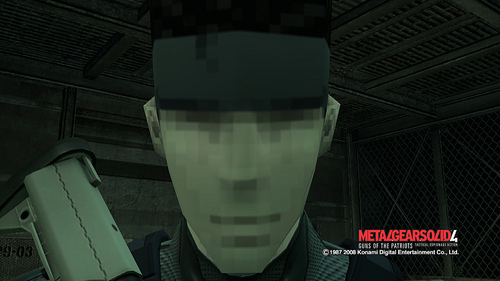
Some context: MGS4 is a weirdly soppy, anxious, nostalgic game, and this section in particular is heavy with an overblown and complex sort of melancholy which I’ll try and unpack as economically as possible here. For one thing, we’re at a point in the (ludicrously incoherent) plot where a succession of rilly terrible things has just happened. The first three acts crescendo, then there’s this interlude of comparative quiet as the hero, Snake, is dropped into a snowy wilderness. For another, this environment - a military base called, with typical MGS portentousness, Shadow Moses - is familiar from the decade-old first Metal Gear Solid game, which debuted on the original PlayStation in 1998. There’s a nostalgic frisson to seeing it again, remodeled to take advantage of the PlayStation 3’s added graphical grunt. There’s also, however, a certain sense of loss or waste involved. In 1998, Shadow Moses possessed an incredible sense of place - of, as the game’s title boasted, solidity. Snake left footprints in the snow, his breath condensed in the freezing air, rats scuttled through the air ducts, icicles depended from the gantries and the place was patrolled by guards who were, by the standards of the era, unusually intelligent and discursive. The base felt alive. MGS4’s Shadow Moses, by contrast, is deserted but for a staff of robots. Dilapidated and assailed by blizzards that periodically obscure your vision, it feels like a ruin. A constant succession of flashbacks, in-jokes and allusions recall the first game – there’s even a mask you can make Snake wear the makes him look like his fuzzy, blocky PS1 incarnation - but rather than underlining how far we’ve come since 1998 these scenes, if anything, suggest the industry has been resting on its laurels. Ten years on, technological advances may have allowed developers to elaborate, refine and expand existing templates, but we’re still waiting for another quantum leap like the shift to 3D.

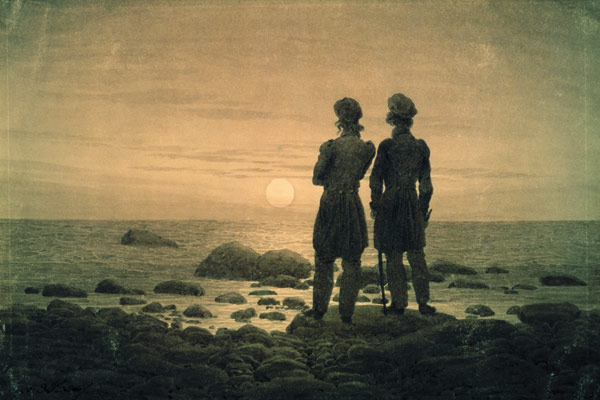
If this rueful attitude is particularly pronounced in the game’s fourth act, a sense of worry and wistfulness pervades the whole production. For an exclusive title meant to showcase the power of a shiny new console (literally shiny: the first PS3 had a buffed metallic chassis) MGS4 was strangely, even ominously preoccupied with obsolescence, finitude and death. Presented with all that extra processing power, director Hideo Kojima put it to use making his hero look lined, haggard and decrepit – a stark contrast not just with his more youthful PS1 and PS2 incarnations but also with the PS3’s polished façade. This Snake’s tendency toward retrospection and self-doubt, his suspicion of a new technological order which is sweeping old certainties away, seem to echo Kojima’s attitude at the time of the game’s development: pre-release interviews address his fear that ‘If the evolutionary roads like the PS3 are closed off, the industry will no longer grow,’ articulating doubts as to the long term viability of the console business which, five years down the line, have been at least partially borne out: the Xbox, an American upstart, has broken Sony’s monopoly on TV-based gaming, consoles in general are thought by many to be going the way of the dodo in an era of smartphones and tablets and the Japanese videogames industry has become increasingly insular, focusing on simple, traditional titles for a domestic audience where, in the 1990s, it seemed to turn out an unprecedentedly ambitious, globally influential epic every few months. I’m exaggerating of course, but this is the kind of exaggeration to which MGS4’s sentimentality and grandiloquence render one prone. In any case, I hope I’ve given some context for the game’s mournfully OTT atmosphere, an atmosphere into which the passage of time, the vicissitudes of technology and commerce and all manner of other non-gamic influences factor, and which is neatly encapsulated in the somewhat Friedrich-esque tableau of a figure with his back to us advancing into the heart of a raging blizzard.

As is probably apparent by now, I’m a sucker for the particular sort of ultra-Japanese macho melodrama MGS trades in. But it’s not quite right to say that the game’s doom-laden atmosphere is what prompted me to reach for MGS4 when feeling extra bummed-out and bereft. Rather it was the way that the game’s melodramatic flourishes throw into relief the way that, on a mechanical level, videogames are totally neutral, unfeeling, objective. The game’s artists might have made Snake look worn and jaded and vulnerable, its writers may have given the voice actor lines that attest to the heavy psychological burden of his traumatic past, but if I mess up and Snake ‘dies’ I know he’ll be instantly resurrected, and won’t manifest any awareness that he was just ‘killed.’ The avatar’s animation might suggest weariness and decrepitude, but he’ll still follow my joypad prompts punctually. And this is because while the game’s designers might intend for a title to evoke a certain emotion, the game itself simply doesn’t care. It won’t go easy on me if I’m feeling blue, nor will it push me out of spite. The computer just follows its orders. It gives me a list of things to do and it acknowledges my doing or failing to do them, completely ignoring the spirit in which and the reasons for which I’ve opted to try and do them right now. As Robert K. Jacob points out, ‘computer input and output are quite asymmetric,’ so while the PS3 throws all manner of data at me as I play (sounds and pictures, text and haptic feedback, music etc.) it receives comparatively little information in return, registering only the electrical pulses I’m sending it via the joypad and disregarding things like my posture, my facial expressions, my sighs of contentment and groans of frustration (though of course biometric feedback systems are beginning to change this…). I play secure in the knowledge that our interaction won’t have any real-world consequences, that the system can’t be disappointed or delighted or bored as a ‘real’ co-player can, that I don’t have to feel beholden or implicated or compromised or any of the other things I might, however reasonably, have felt were I playing with someone else. In short it was the tension between the systematic and the schmaltzy that rendered the game so appealing – and the something similar goes for my other go-to at this point,  Demon’s Souls, wherein the aesthetic layer is all amped-up eldritch fantasy while the mechanical layer is about discipline, repetition, patience.

This sort of play definitely fits Warhol’s description, with the games console operating as a ‘anti-effeminate technology of feeling’ insofar as it helps us avoid giving way to – or at least being seen to give way to - patterns of response our culture codes as effeminate. I’d argue that it would be wrong, however, to dismiss this type of play as nothing more than a poor substitute for or means of avoiding ‘real’ consolation and company (which is not to deny that it can also be that). It would also, I think, be wrong to see the feelings it can elicit simply as a matter of the production of an intended effect (catharsis, poignancy, wistfulness) being undercut or sabotaged by our catching a glimpse of the algorithms underpinning it. Yes, there are tensions, asymmetries and contradictions here - between the sentimentality of the game’s diegesis and the objectivity of its underlying systems, between the powerful affects to which games can give rise and their inability to register any but the most concrete and unambiguous forms of response -but rather than one element cancelling the other out, you often see forms of juxtaposition and interplay that are moving on their own account, capable as they are of reflecting and eliciting feelings of ambivalence and self-consciousness. As Gone Home – a brilliant asocial game that aims to foster distinctly ‘effeminate’ affects – demonstrates, games can be a great medium for exploring loneliness, aloneness and the separability of the two, for thinking about technology in terms of the mediation or deferral of contact, for dissecting the impetus toward asociality.


(Friedrich sunset from here, Viz image from the late, lamented UK Resistance)

Friday, 19 April 2013

Demakes as Procedural Caricature?


Wondering if there's some interesting purchase to be had on videogame demakes via the idea of 'procedural caricature'.... Bergson talks about caricaturists seizing on features/characteristics that bespeak 'recalcitrance,' immobility, the machinic; demakes take caricature from the realm of synchronic representation to that of diachronic simulation, hyperbolically approximating the most sailent (or ridiculous) routines, procedures, mechanics.... Normally the gag is pretty cheap - made in the service of making us feel fond and nostalgic, or smug and superior. There's fascinating potential in parodic software though - seems like this is sort of what Pippin Barr's latest project is getting at...

Tuesday, 9 April 2013

Lawnmower Inferno

So this week Lovefilm engineered one of those unexpectedly felicitous double bills, serving up Lawnmower Man alongside Inferno, a documentary about the disastrous and abortive shooting of Henri-Georges Clouzot’s L’Enfer. What turned out to link the two was SFX, with both films using lurid colours and lysergic patterns to communicate a loss of innocence: in Lawnmower Man a holy fool becomes a megalomaniacal cyberbeing, while in L’Enfer a husband is beset by surrealistic visions of his wife’s infidelity. Seeing the two in tandem, I was struck by the fact that, effectswise, they’re essentially coming at things from opposite angles: if Lawnmower Man’s animated sequences see computers clunkily attempting to replicate organic forms, one of the most moving things about Inferno is watching Clouzot’s team inventing ingenious and laborious analogue processes that produce results now reminiscent of nothing so much as the presets available in digital playback and editing software... Ripples, meshes and mirror images, hallucinatory composites and freakish colour schemes are conjured from rotating arrays of lights, sheets of water, layers of plastic and cellophane, sequins and ungents, wires and mirrors. Determined to turn a lake blood red, but unable simply to hit cmd+i, Clouzot dickies with the colour timing, has the make-up department paint the actors a cadaverous grey-green and commissions two sets of costumes - one for each side of the colour wheel.


 In both cases, and even more than in the typical effects-led film, there’s an excessive, flagrantly artificial quality to the SFX sequences. Not content to humbly serve the story, they demand attention on their own terms, as technical achievements. As if acknowledging this, Lawnmower Man’s title screen offers the option to watch just the computer-generated bits, skipping the film that frames them altogether. With L’Enfer, meanwhile, it’s almost as if Marcel’s hallucinations (which are the only scenes that take place in colour) literally refused to be integrated into a finished film, the flimsy narrative architecture designed to support them buckling under the weight of their sensory charge. While the documentary does a decent job of interweaving a sketch of L’Enfer’s plot with the story of its production (a story climaxing with the shock resignation of leading man Paul Reggiani and Clouzot’s subsequent heart attack) these contexts start to seem irrelevant faced with the sheer charisma of the surviving footage. I found myself wishing that they’d just given us a menu of these fragments to watch in whatever order we pleased rather than subordinating them to the (albeit fascinating) history of the project - which desire led to me capping and gif-ifying the bits of it I have.

In this respect, these films also highlight the weird irony of the DVD, a storage medium that allows for random access but which (at least in the case of DVD movies) masquerades as a film strip, surrendering images in a linear sequence. You could argue, in fact, that both movies fail because they attempt to tell A-B stories about things that are inherently non-linear: if it’s no surprise that Lawnmower Man can’t turn the internet and the videogame into material for compelling non-interactive entertainment, it’s perhaps strangely apt that Clouzot couldn’t work a profusion of rushes, alternate takes and freestanding optical experiments into a viable feature film: after all, Marcel’s paranoia can itself be understood as a state of narrative crisis, whereby the proliferation of terrifyingly plausible possible pasts and futures foils any attempt to reach a definitive understanding of what has happened or might happen. Trawling tumblr suggests that both films are fated broken up and strewn, contextless, across a thousand microblogs - but maybe that’s poetic justice?

Lawnmower Man images from:
http://www.virtualworldlets.net/Worlds/Listings/LawnmowerMan/LawnmowerMan1-Falling.jpg

Friday, 15 February 2013

The Surface of the Moon


Scratched CD (image from wikipedia)


So I wanted to write something about Neil young’s Harvest Moon, a record that I’ve become peculiarly attached to over the past couple of years. I say peculiarly not because the album isn’t generally highly thought of (it is), but because I tend to have a pretty low tolerance for bluesy, folksy Americana with lyrics about Harleys, hound dogs, and prairie grass. So why do I like this LP? I think it’s because, while it initially comes across as ‘timeless’ and ‘effortless’ (or, as a more cynical listener might say, rote and generic) you can, if you listen more closely, hear Young wilfully and not always successfully struggling to divorce himself from the here and now, an effort which invests the record with a weird tension that I find both fascinating and moving. When Young claims he’s just doing what comes naturally (‘Here I am with this old guitar / Doing what I do’) he’s being at once basically truthful and deeply disingenuous, and the graft that’s gone into making everything sound assured, serene and spontaneous imbues what might otherwise have seemed like a pastiche with a King Canute-type pathos.

As wikipedia will tell you, Harvest Moon is generally considered a sequel to 1972’s Harvest, and was recorded in the early ‘90s, in the wake of a bout of tinnitus Young incurred while cementing his status as patron saint of grunge. Heard out of context, however, you’d probably think it dated from around the same time as Harvest - indeed, I’ve had conversations with people who love and have long owned the record but had no idea that it was released in 1992. For one thing, this presumably means they missed out on the superb photo of Young and band in the booklet packaged with the CD version I have (which photo I tragically can’t find online): not only is everyone looking pretty ravaged, but the preponderance of tie dyed tees and denim cut offs locates us squarely in the 1990s. For another, it suggests they haven’t listened too closely to the lyrics: opener Hank to Hendrix, for example, namedrops Madonna (‘From Marilyn to Madonna / I always loved your smile / Now we’re heading for the big divorce / California style’).

The Madge reference highlights the tension that make the album so interesting for me: is la Ciccone being conjured as avatar of all that’s wrong with contemporary culture (as she is in Roger Kimball’s adorably flustered postscript to Tenured Radicals), or is Young positing an equivalence? Does the comparison impose continuity on pop cultural history (yesterday, Marilyn; today Madonna - plus ca change, plus c’est la meme chose), or is it meant to describe a trajectory from the authentic to the ersatz? Such moments highlight the contradictions inherent in adopting a reactionary stance* - the problem, for example, of reconciling the desire to believe certain things are natural and essential and will always be with the conviction that right now we’re going to hell in a handbasket - and disrupt the attempt to keep things cosily nostalgic. We become uncomfortably aware that someone probably had to invent Harley Davidsons and guitars at some point; that they used to be - ugh! - new.

Speaking of technology, later in Hank to Hendrix there’s a verse that I can only hear in terms of Young’s notorious antipathy to digital music formats (so inveterate is Young’s hatred of CD and MP3 that he’s begun touting his own file format, ‘Pono’ - named, naturally, for the Hawaiian word for “righteousness”). It goes:

Sometime it's distorted
Not clear to you
Sometimes the beauty of love
Just comes ringin' through.

The same theme’s engaged in more explicit terms in the closing track, Natural Beauty. Here which Young sings about having ‘heard a perfect echo die / into an anonymous wall of digital sound’ before asserting ‘a natural beauty should be preserved like a monument to nature.’ It’s here that the consonance between what’s happening sonically (the desire to create something hushed, pure and lilting, catalysed by tinnitus and rendered tougher by the quavering reediness of the ageing Young’s vox) and what’s happening lyrically/thematically (the desire to conjure a mythic never-never-America, compromised by Young’s inability to avoid references that locate us in the abject present) are strongest.

Ironically, what the results most remind me of is a hard disk drive - a device that, incidentally, has more in common with a ‘proper’ analogue record player than you might think. Sealed off in a hermetic container in the bowels of the computer, the HDD comprises a series of platters made from highly finished aluminium or silicon, onto which data is written in clusters comparable in size to blood cells and anthrax spores. Read by drive heads that skim micrometres above them on cushions of air, these platters are exquisitely vulnerable to smudges, scratches and faults - and in this respect they resemble Young’s artfully evoked fantasy USA. Listen carefully (as a paranoid audiophile, searching for evidence of digital signal compression, might) and a series of flaws - the catches in Young’s voice, the ‘anachronistic’ references to digital media and MTV - compromise the comforting idea it’s still 1972, tarnishing the illusion.

The effect is strangely reminiscent of Borges’ story Pierre Menard, Author of the Quixote - an account of a writer who attempts not merely to translate or copy Cervantes’ masterpiece, but to recreate it ‘word for word and line for line.’ For Borges’ narrator, Menard’s 20th century Don Quixote ‘infinitely richer’ than Cervantes’ (identical) 1602 version. This is because what are, in the mouth of a seventeenth century Spaniard, mere rhetorical commonplaces, doxa and formulae, become, coming from ‘a contemporary of William James,’ audacious, ‘astounding’ conceits. Likewise, to release Harvest in 1972 is one thing, but to release Harvest Moon in 1992 is quite another. While I’m aware that championing futile acts of heroism is an activity with dubiously conservative overtones, I find I’m with Borges when it comes to which is more fascinating.


*Young’s, of course, traditionally been way too interested in and conflicted about the technologically and culturally new to be tagged as a straight up luddite (witness Trans)...


Tuesday, 3 March 2009

Vermoulu


Just read, via Steve Baker's The Postmodern Animal, about Helen Mayer Harrison and John Harrison's project Casting a Green Net: Can It Be We Are Seeing a Dragon? which saw the two artists delimiting an area of the Pennines bounded by the Humber, the Mersey and misc. Roman roads in order to consider cultural and ecological interlinkages within it. Only when they'd set these bounds did they find they'd outlined a dragon. Wilfuly hallucinated out of OS maps, the Harrisons' dragon - with its two marigold wings and beaked profile - is illustrated above, as are a couple  of AGF's even more Rorschach-y blot-dragons. It's kind of like the woman-shaped map in Rider Haggard's She (with regard to which, transposed into a chic Gallic electro register, this too).

Dragons, as the mapping of one onto (or maybs the discovery of one within) the Pennines suggests, are instruments of territorialization and deterritorialization. Always occupying as-yet unmapped frontiers  (hence 'here be dragons' plus also 'It Came from Outer Space') they embody the negotiation of borders - between places, between species, between the real and imaginary. AGF's Dancefloor Drachen - the LP which the inkblot dragons were produced to illustrate - is about digital property, about modes of acquiring and altering others' music in an age when bricks&mortar pressing plants & record shops are increasingly superfluous, and is as such preoccupied with shifting boundaries. 
As with giants and Krakens, dragons speak to a kind of animistic need to imagine animals on the same scale as the landscape, who are or at least are able to shape that landscape, animals the forms of which are suggested in rockfaces and bunched clouds - hence the Rorschachiness of AGF's and the Harrisons' dragons.  Also pictured above is a plastic dragon-islet playset which I owned as a kid that opened up and had a smaller dragon in it. Pictured too is Shadow of the Colossus, a recent, deeply melancholy videogame where you kill 16 behemoths that turn, dead, to piles of mossy rubble which look from the right angle like like the monsters they used to be pre-ossification. The game takes some design cues* from the earlier Panzer Dragoon Saga, wherein you rode a dragon over ruins and deserts. One of the interesting things in Panzer was the dragon's malleability; there's three images above of the screen where you moved a cursor between 4 points in order to genetically reconfigure your mount in real-time. Aspects of the dragon would evoke a rhino, a narwhal, a cricket, a gecko, an egrit without its ever looking entirely like any of them, or even like a straightforward chimera-like composite. 

Reading Baker grapple with Deleuze and Guattari's notion of 'becoming-animal'  - which has to do with creating new, contingent combinations of attributes, with multiplicity and metamorphosis, 'deterritorialization' and the liquidation of known boundaries -  reminded me of this facet of the game. Becoming, in the Deleuzo-Guattarian sense, is not a matter of A turning into B or A + B turning into C but of perpetual, indefinable flux (nothing is and nothing becomes; everything is becoming) and  'becoming-dragon' is no more or less viable than 'becoming-antelope.'  As often w/ Deleuze, its an attractive idea insofar as it gets close to something of the way I find I think or intake stuff. I spent the lengthy tail-end of a recent party propped up frazzledly watching maybe 4 hours worth of Planet Earth, hours which are only now imperfectly recoverable - so that while there's odd gestures or textures or images that've stayed with me I can't, for example, say just what species the animal that tore out a long, red shoehorn of inner neck from another animal on a pebbled, spumy shore was - I've just a sense of scattering, slickness and blubber, mingled somehow w/ tactile data from the bubblewrap on the fancy-dress costume of the girl sat next me. The emotional residue smacks a bit of being a kid, back when it was okay to imagine or credulously read about or draw up dragons.


*not to mention its mood (which is that sort of bereft, coastally-salty bleakness you get in Old English poetry) plus a taste for portentous Engrish titles

(AGF's dragons from her website, poemproducer, worth-seeing-in-motion dragon morphing from this vid, Dune-y colossus from here, OS map dragon from Steve Baker's The Postmodern Animal, dragon islet from here)

Thursday, 18 September 2008

Rom-hom-horror


I finally saw Ring, which, gratifyingly, was pretty great.  Bar the cursed VHS conceit I knew zero about the plot, which ended up really reminding me of some of the ghost stories crotchety lesbian aesthete Vernon Lee was writing in the late 1800s. Those are almost all about how brainwork and research establish dangerous, selfhood-compromising links w/ the dead. They've got this deeply queer and melancholy  quality; all the protagonists feel estranged from their own time, like they'd only be understood by these dead figures they fixate on. As Terry Castle's argued there's a pretty venerable literary tradition where ghosts are readable as i.e. thwarted sapphic passions. Lee belongs to it, but it was unexpected to find that Ring does too...

There's that amazing bit where - having exhaustively researched Sadako, psychically tapped her memories then tres symbolically dredged the well she was flung down - the main character, a female journalist, has this cathartic embrace w/ Sadako's sodden corpse. The whole mediate, queerly fraught relationship is totally Lee and the hug's really moving - more so, say than when yr supposed to be happy for Molly Ringwald and the yuppie guy at the end of  Pretty in Pink.

///BONUS queer non-sex scene from a film of the last decade///
Also I watched Iron Man the other day, and was really reminded of Zizek's contention Edenic sex would be dispassionate, mechanical, basically rectological during the bit where Gwynnie has to deftly manipulate the circuitry inside the prone RDJr's chest cavity, and it's a totally above-board clothed scene in which she's basically fisting him... Bits of that movie (inc. Ghostface aka Tony Stark contributing to the OST, drolly) were pretty interesting, really.

(singer Sargent's portrait of his buddy Vernon Lee from paintingall.com, Sadako's toilette from obrasilero.com, Nanako Matsushima's Shelley Duvallesque gawp (always cast big-eyed, slightly mucoid-featured potential victimesses = rule 1 in telepathic horror) from windowtothemovies.com)


RIPDFW


So CBS went w/ the above, none more obit-ty photo. Never really had a generational figurehead/personal hero die, by way of their own hand or otherwise, during the hormonally volatile years in which I imagine that sort of thing would have seemed highly profound (though I do recall everything seeming pretty thanocentric circa ODB, John Peel and Yassir Arafat popping their respective clogs almost simultaneously) but this has reacted with trivial, subjective sadnesses of mine in a way that's sort of surprised me. I heard via e-mail, having just replied to a message re: a piece on  Sarah Kane I've been writing and while watching Richey Edwards' last interview on tube, as if the crux of the crossroads they'd all have been buried under in the olden days was the middle of my browser window.

(wistful troubadourish foto, cbsnews.com. Copious, interesting tributes at http://www.edrants.com/remembering-david-foster-wallace/)

Thursday, 21 August 2008

Where then's now


Just back from the Edinburgh festival, where I saw Grezegorz Jarzyna’s production of  S. Kane's  4:48 Psychosis, the one she wrote before/about topping herself. Couldn't work out if the turn of the century costumes, which made me think of stuff Kim Gordon's clothing line put out back in the day, were intentional or just, like, a Polish thing. Then I  remembered that - kind of like that disney island where it's NYE every night or maybe like outsourcing call centres to the subcontinent or having yr photos backed up on a server somewhere or an otter sanctuary - East Europe is where the pre-millennial anglo angst slack gets picked up nowadays, to prove which I've dredged up a  flyer for the 2k7 Exit festival in Serbia (the prodigy played, so did basement jaxx and lauryn hill); you'll plz note the Face-esque layout + effulgent, lime-toned Matrix type and take for granted I can barely see my keyboard for dewy-eyed nostalgia

(4:48 pic from eif.co.uk, proj from exitfest.org, strappy topped festival girl from the exit festival's myspace, subcontinental nuclear testing from en.wikipedia.org/wiki/1998, auntie kim from Kim Gordon Chronicles Volume 1 (cheers Jok))